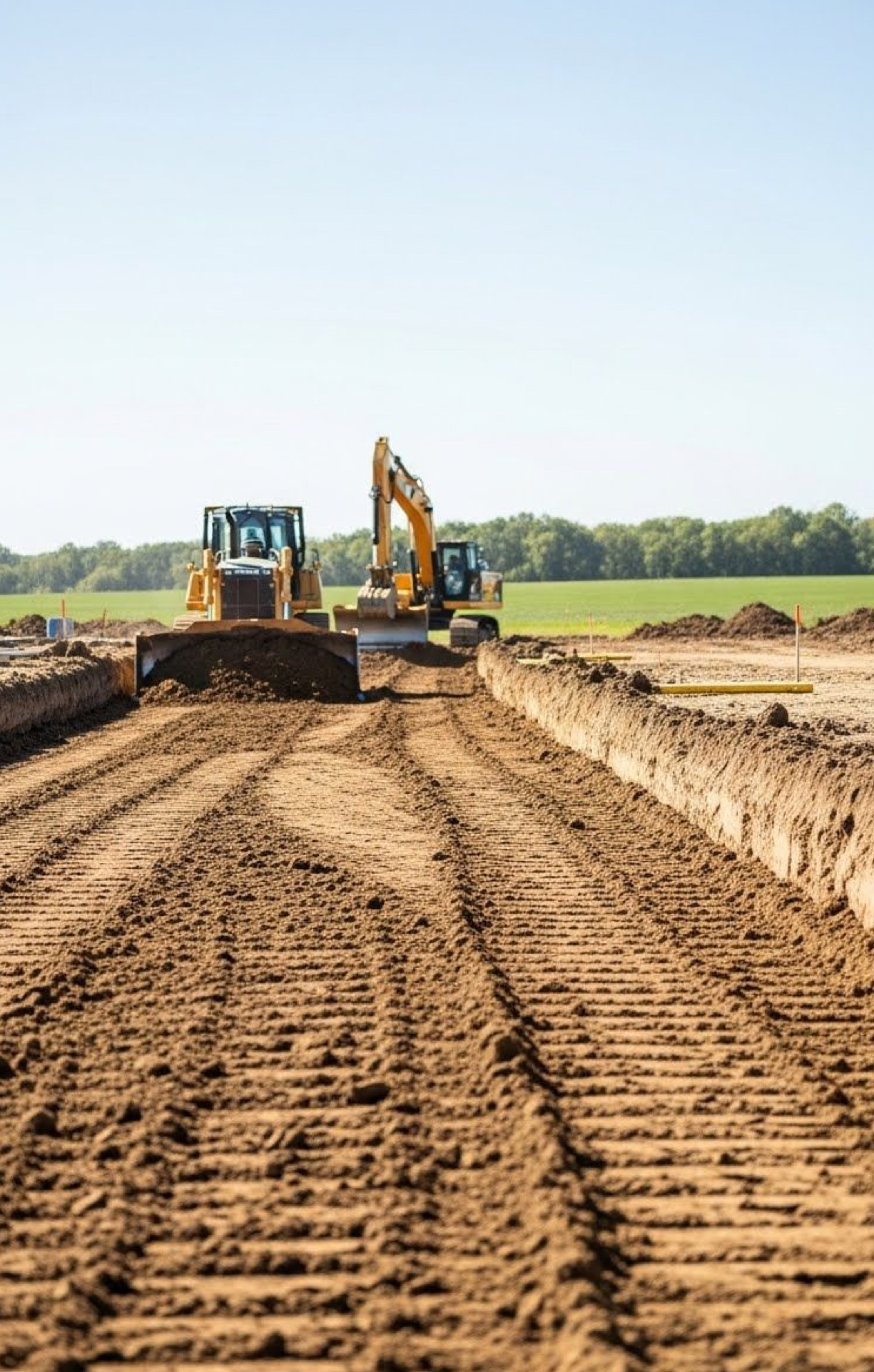
If you're talking to an excavator about a build, you're going to hear both "rough grading" and "finish grading" thrown around. They're not the same thing — and knowing the difference helps you ask better questions, spend your money in the right places, and end up with a site that actually drains the way it should.
Rough grading is the big-picture dirt move: shaping the site to roughly the right elevation, getting the basic slope set, moving spoil where it needs to go, and prepping pads for foundations or building footprints. Tolerances are typically a tenth of a foot (about an inch and a quarter). Finish grading is the tight, accurate final pass: laser-leveled or GPS-guided, sloped for positive drainage, with topsoil placed and smoothed, ready for sod, seed, or concrete. Tolerances are fractions of an inch.
Skipping rough grading means your finish guy is fighting too much dirt — burning time and money moving material that should have been moved by a bigger machine earlier. Skipping finish grading means water doesn't drain right, your sod sits in puddles, your driveway settles unevenly, and you're back out there with a shovel every spring. Both passes have a distinct job — and skipping or shortcutting either one shows up later.
Rough grading uses bigger equipment — dozers, excavators, larger skid steers — and bigger tolerances. The goal is to get the site close: building pad at the right elevation, drainage swales roughed in, spoil piles staged out of the way of upcoming trades. Finish grading uses laser- or GPS-guided equipment to dial slope and elevation down to fractions of an inch, places topsoil to a uniform depth, and rakes the surface clean. We do both, and a big part of the value is knowing when to stop rough and switch to finish — push rough grading too far and you waste money; stop too early and finish takes twice as long.
On a new home build, the sequence usually goes: clearing, rough grading, foundation dig-out, foundation pour and waterproofing, backfill, utility trenching, more rough grading once everything is in, framing and exterior work, then finish grading at the end before sod or seed.
Finish grading is one of the very last things to happen on a site. By then, every trade has driven over the dirt, dropped material on it, and generally torn it back up. That's why a separate finish pass exists — to undo all that and leave the property right.
The cosmetic part of finish grading — smooth, even, ready for sod — is what people see. The functional part — positive drainage away from the foundation, swales that move surface water to the right outlet, no low spots that hold water — is what makes the property last.
The minimum we shoot for around a foundation is 6 inches of fall in the first 10 feet. That's not a guess; that's the IRC code minimum, and it's the single most effective thing you can do to keep water out of a basement.
On a small site with simple drainage and clean material, we can sometimes roll rough and finish together. On a complicated site, with topsoil to strip and stockpile, multiple pads, and traffic from other trades, they have to be separate operations weeks or months apart.
When in doubt, plan and budget for both. Combining them is a bonus when it works out, not something to count on.
Almost always, yes. Even a simple driveway pad usually benefits from a real rough grade followed by a real finish grade. The only common exception is a tiny patch repair where there's nothing to rough.
Sometimes it's the excavator, sometimes it's the landscaper. We do both, and we coordinate with whoever's doing the sod or seed so the handoff is clean.
Tenths of an inch over hundreds of feet. It's the difference between a yard that drains predictably and one that ponds in three different spots after every rain.
If any of this sounds like your property, give us a call. We'll come look, tell you straight what the actual problem is, and quote it free. Call 320-349-0354, email contact@rileysiteworks.com, or use the form.
Call 320-349-0354 or send us the details and we'll come back within 24 hours with a straight answer.